Rapid UX Research with AI Support
7 minute read
Last year, our team decided to move past the hype and actually work inside the world of vibe coding.
Vibe coding, a term coined earlier this year to describe chat-based, AI-driven tools that generate deployable applications from natural language prompts, was everywhere. The promise was simple and seductive: go from idea to working app in hours, without writing traditional code. But instead of asking “Can it build an app?” we asked something more practical:
So we designed a real experiment: a one‑month, structured, iterative sprint using vibe coding as our primary build method.
The One‑Month Vibe Coding Sprint
We gave ourselves 30 days. We met twice a week for structured co‑creation sessions, not just prompting, but planning, reviewing, breaking things, rebuilding, and refining. The goal wasn’t speed alone. The goal was to learn how this actually works in practice when treated as a product workflow rather than a novelty.
We chose a problem space that was both practical and meaningful. A fridge/freezer inventory app:
It had broad appeal (anyone who’s ever discovered a mystery container in the back of the fridge), but also real utility for people who are blind or low vision and can’t visually scan shelves. This gave us a perfect test case: something simple on the surface, but complex in execution.
Our Vibe Coding Toolkit
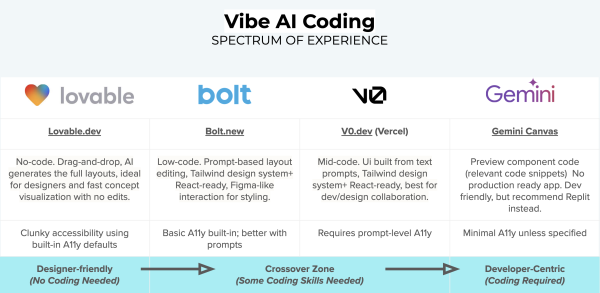
We tested multiple platforms:
Some leaned towards low‑code and non-developer-friendly. Others were more developer‑centric. For our sprint, Lovable and Bolt became our primary tools; they were fast, intuitive, and well-suited for rapid iteration and prototyping without heavy engineering overhead.
(Side note: since our testing, some of these platforms have raised significant funding and evolved quickly, but the structural lessons from our sprint still hold.)
The Real Shift: From “Build Fast” to “Iterate Well”
The biggest learning wasn’t speed. It was iteration quality. Yes, vibe coding gets you from zero to something clickable very fast. But the real question is what happens after that first build:
The answer: Yes - but only if you treat it like a product process, not a magic trick.
We learned that vibe coding works best when structured as:
This wasn’t linear; it was cyclical.
Prompting isn’t “telling the AI what to do.” It’s designing system behavior through language. Short prompts produced inconsistent results. Overly long prompts led to a loss of coherence. The sweet spot was structured, intentional prompting:
Good prompts created stability. Bad prompts created chaos.
Even with AI, product fundamentals didn’t disappear:
Vibe coding doesn’t replace product thinking; it amplifies good product thinking and exposes weak product thinking.
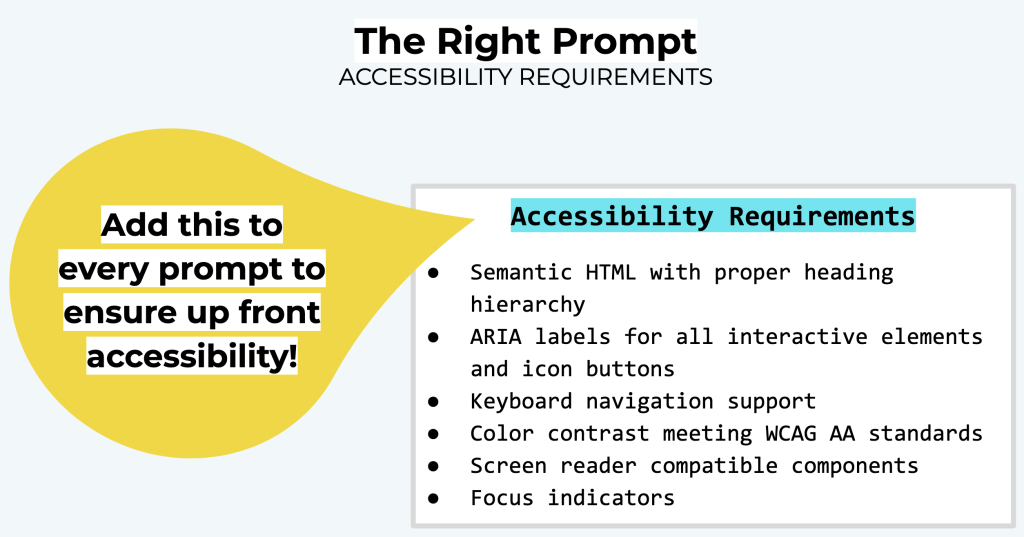
Accessibility was part of the sprint, but not its center. Out of the box, the builds had:
Technically accessible, but not always usable. The experience improved only when we intentionally prompted for experience quality, not just compliance:
“Smooth screen reader navigation with minimal repetition”
“Descriptive item labels optimized for non‑visual scanning”
This showed us something important:
Accessibility in vibe coding isn’t automatic, but it is achievable when treated as a design requirement rather than a checkbox.
Trying to connect everything at once broke things fast. Our best build sequence was:
Vibe coding works best in layers, not leaps.
AI output always needed refinement:
The model accelerated production, but humans ensured quality.
Vibe coding didn’t replace design. It didn’t replace engineering. It didn’t replace strategy. It changed speed, feedback cycles, and iteration cost.
We could:
That’s the real value.
Vibe coding isn’t a no‑code fantasy. It’s not a magic wand. It’s a new product workflow. Think of it as a co‑pilot, not an autopilot:
The real shift isn’t technical. It’s cultural: From building slower but safer → to building faster with smarter feedback loops. That’s what our one‑month sprint actually taught us. And that’s where the real opportunity lives.